Keynote
Address Given At:
Association of Foreign Investors in
Real Estate (AFIRE) Annual Meeting
September 26, 2005
Dr. Rajeev Dhawan Director Economic Forecasting Center

Stephen J. Zoukis
Welcome to the 17th
Annual AFIRE Membership Meeting. In particular, we welcome our new members and
guests. Since our last conference, 23 new members have joined, bringing our
total to 177, our highest ever, hence the big attendance.
As you know, the theme of this
year’s conference is This Is Not Your
Father’s Real Estate Business, a phrase we borrowed from the now-defunct
Oldsmobile car company. We could as well have used a line from the great Bob
Dylan (who is on PBS tonight): And
Something Is Happening Here But You Don’t Know What It Is, Do You Mr. Jones?
We hope we’re going to help provide some insight.
I think we all agree that we find
ourselves in somewhat unfamiliar circumstances right now, and while we might all
generally agree on what the facts are, the significance of the situation is the
subject of a lot of debate. Our presentations are intended to help sort this
out by addressing new types of deals people are doing, new places they are
doing them, and new players entering the real estate market. Tomorrow morning,
Mr. Bill Sanders will take a stab at putting this in a big-picture perspective
for us.
I’d like to thank the top-notch
AFIRE staff, who make my job with AFIRE a piece of cake. Those of you who may one
day have the privilege of serving in this position shouldn’t fear it, because
Jim and Lexie and Soo really take care of everything. They make the chairman’s
position a very easy job to handle.
I would also like to thank the
sponsors of this program. We made the decision some years ago to rely on
sponsorships to cover a large part of the cost of conferences such as this, and
we have been at it long enough that some are stepping up for the second or even
the third time. So special thanks for this conference’s sponsors: GMAC, ING,
AEW and its European counterpart IXIS AEW,
With all of that said, I would like
to introduce our first speaker, a fellow good old boy from the South. Dr.
Rajeev Dhawan is the director of economic forecasting at
Dr. Dhawan was educated in
Dr. Rajeev Dhawan
I’ve been thinking about changing
the advertised title of this session from As
the World Turns to As Katrina and
Rita Do Damage to Us.
In that vein, or maybe just to give
you an idea about how cheap I am, I have a little story. My girlfriend demanded
that I take her to some place expensive … so I took her to the gas station.
That is what Rita and Katrina have done to gas prices. I used to live in LA and
had already seen gas at $2.50. I thought I could live with it. But just to
shock myself, I filled up three weeks ago at $3.79 a gallon. At that moment I
figured out how I could get 20 percent more efficiency. Having to pay the price
spurred the insight, so everybody has a price limit somewhere. The specific
limit depends upon the person, but the point is, as prices go up we will
conserve on energy. The issue is what damage it does to the economy.
So is Katrina, on its own, going to derail the
In the last couple of days, the
question has been whether Rita, on its own, is going to derail the economy. As
it turns out, Rita did not hit head-on as it might have. So far, the report is
that refining capacity may be down for a little bit, but nothing seems to be
damaged. But remember, when Katrina happened the first impression was that we
had dodged the bullet. Only later did the news come that the levees were broken
and the water was coming in.
So with Rita still blowing, we don’t
fully know the extent of the damage, especially to the refineries. If damage
there is extensive, then between Katrina and Rita, about 50 percent of the
So are Rita and Katrina together going
to make for the perfect storm? Still the answer is no. Given the information so
far, it’s not going to cause any problem. So if you are waiting for a recession
to change your business, it’s not going to happen. Insurance companies, for
example, can’t assume they’ll see a higher ten-year bond rate resulting from
the hurricanes, not that easily.
Dr. Dhawan
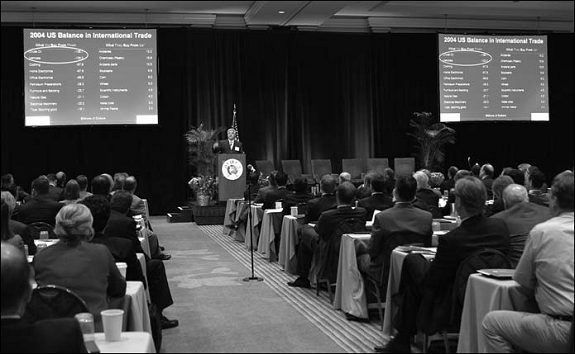
addresses the general session.
Let me show you the outline of how I
calculate the impact and you can make your own calculations. Factor number one
is refinery damage. Figure out how much has been damaged, how much is back
online, and what time it will take.
The next thing is consumer confidence, which
shouldn’t be a big factor, but psychologically these events have an impact. The
In my calculation, I have these things happening in
September-October and then slowly starting to recover by January, as
One small fact played up in the
media until recently is that about 10 percent of the natural gas capacity is
off-line and won’t come back for another three to six months. Refineries may be
back in service by the end of this month or early next, but not the natural
gas. This will of course cause a shock with the bills in December and later.
It’s definitely coming; the issue is how they slip it in. What kind of a price
increase they will be able to do is going to be an issue.
The next factor is monetary policy.
The Federal Reserve (Fed) will keep on with its “measured coast.” It will keep
raising rates, which I think will go up to 4.5 percent by the time Greenspan
leaves office in January. The Fed is not going to stop, and may even have to do
a stronger hike in the end just to shock the system, because housing construction
is getting out of control. Two million housing starts is just way too strong. I
will have some opinions about that later on.
The ten-year bond rate remains a
little bit low. I am going to examine in detail today how, in this booming
economy where the Fed has been raising rates for the last year or more, the
ten-year bond rate has actually come down. Why has that happened? Who is
responsible for it? And what is going to keep it going that way for a while? It
has given a big break to homeowners and to things like your cap rate
calculations.
The first factor I mentioned was the
impact of the hurricanes on gas prices. In my calculations, I have put in a
spike in gasoline prices, the average rising from $3.00 to $3.25, and then
quickly coming down. I was preparing this forecast three days ago, before Rita
came in, although the media was after me to talk about the impact of Rita. It’s
a bit like asking me to do a post mortem on a body where the murder has not
even been committed — the event hadn’t even happened.
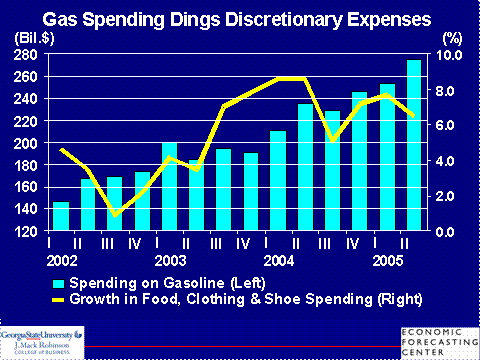
I want to show on this graph (Graph
1) how the oil prices go through the system, and why it should or shouldn’t
make an impact. The blue bars show, from the GDP income accounts, what we spend
on gasoline. The
But where are we going to get this
extra money? For some of us here it may not be a big increase, but where will
average folk, making $50,000-$60,000 a year, get that money? The national
income accounts show us spending by very detailed categories. I looked at
spending on food, clothing and shoes and it seems that people took the money
out of a category called discretionary income spending. It also seems to come
from spending on recreation; for a typical guy that means it’s coming out of
his beer and poker money, which causes a lot of grief. He can’t go back to the
wife looking for extra money for the gas habit, so he has to take it out of the
beer and poker money. Although the real impact is not that much,
psychologically its nasty, and that shows up in consumer confidence, which
often leads to a slowdown in spending three to six months later. If arrested,
this won’t be a problem.
The outright tax cuts in the Bush years have helped
us out, particularly in contrast to the 1970s. The oil price shock in the ’70s
occurred at a time when people were facing increasing taxes caused by “bracket
creep.” (Taxpayers kept moving up in the tax brackets without actual tax rate
hikes.) But now, the Bush tax cuts have absorbed the energy price shocks and
helped us along. Additionally, many people have refinanced numerous times in
the last two years, blunting the cash-flow issues presented by the hikes in gas
prices.
Returning
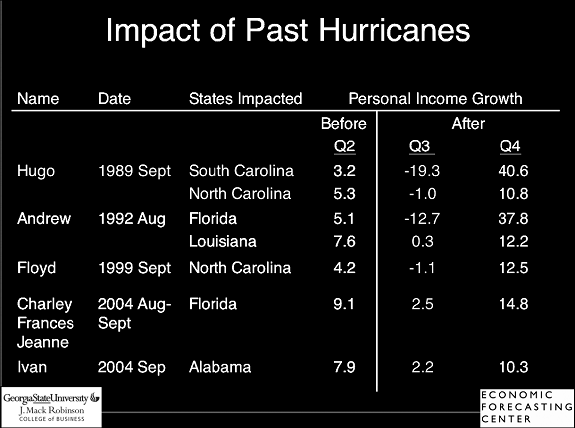
to the impact of the hurricanes, consider the typical pattern. When a local
economy is doing well before a hurricane hits, which typically happens in
August and September, income in the local area usually takes a big plunge in
the third quarter. Then, as the rebuilding begins, it comes back like a rocket.
So the farther you fall the faster you come out.
In the case of hurricane Hugo,
income dropped off 19 percent in one quarter, and rose 40 percent the next
quarter (Graph 2). It looks like the impact of the hurricane on the local
economy lasted one quarter at the most. In the employment data you can’t even
find an impact.
The destruction of a house is not counted as a
negative in the GDP, because it affects the capital stock. But when you build
it again, it generates income and gets counted in the national income records.
So whichever way we count it, it is a one-quarter hit. This storm is going to
affect two to three quarters because of the impact on consumer confidence.
I had just released a forecast on
August 24 and all of a sudden I had to create a new one. In the revision I put
in about a 10 percent drop in consumer confidence in the coming months.
Thereafter, you see recovery as the rebuilding begins. There is a very minor
drop in automobile sales — minor because we keep on buying the cars. (And why
wouldn’t we? If GM, Ford and Chrysler are basically giving you the gas guzzler
and offering the $5,000 that pays for your gas for the next four years, why
wouldn’t you take it? So people are doing that. It’s a big game, of course,
taking the money out of the shareholders’ pocket and giving it to the people,
but it’s not going to stop.)
Inflation
will peak up, which it has already begun to do this quarter, but it is a
temporary blip. The Fed will counter it and it will come back to normal. The
ten-year bond rate will actually dip a little bit lower than the level I
mentioned before. But the biggest impact is on the housing stocks, because
availability of supplies will not be easy. They say lumber, cement and other
materials are in short supply, which is going to hold back a little bit on
building.
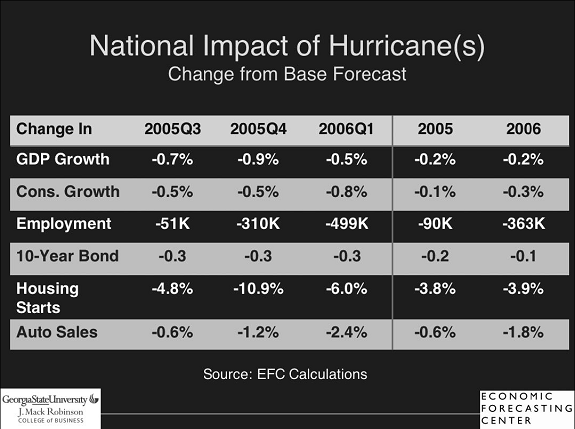
In the long run, there is no net
loss. What you lose over here in the GDP growth you make up later. The biggest
impact is in the fourth quarter, where I see a drop of almost 1 percent in the
GDP growth rate. But if you average it out over the four quarters, the drop is
only 0.2 percent. So we can say with a straight face it’s not a big impact, but
a very big quarterly impact for one quarter (Graph 3). So that’s the effect of
these hurricanes.
Looking at “how the sausage is made,” virtually all
of the impact is coming from higher gasoline prices cutting into discretionary
spending and from the drop in housing starts. Without the drop in housing
starts, the economy wouldn’t be affected nearly as much.
What else is going on in the
economy? The overall economy is fine, though we do have some problems. One of
the problems people really care about is the trade deficit. To think about the
trade deficit, I go home to
Considering oil production and
consumption four years ago and now (i.e., considering the net change in
supply), it turns out there are two big contenders putting the pressure on the
oil market. One is the
The oil market is not like the stock
market, where you pick up the phone, call the broker and take the oil. It’s
about relationships, contracts, politics and geography.
Taking into account those realities,
you find that it was
At that point, Goldman Sachs feels
the pinch, and reasons that in the stock market managing money for a 3, 5 or 7
percent return is not going to make its high-net-worth individuals happy. So
Goldman decides to get onto the bandwagon, into oil trading. All of a sudden
you have the speculators, hedge funds, Goldman Sachs and everyone coming in and
it builds up momentum. It’s like bidding on a house in
But
in between you are going to think about one thing. You may want to ask Colin Powell
today this question. Who in the future will have the excess oil? The answer is
There’s one reason why Condoleezza
Rice visited
The other thing going on right now
in
When you go to an economics class
they will tell you what causes the ten-year or the long-end bond to go up.
Typically the factors are inflationary expectations, what the Federal Reserve
is trying to do, and the liquidity/ safety premium. These would come up in a
finance class. And the last but not least, according to me, is the trade
deficit. I’ll show you the statistical indicators later, but let me very
quickly build up the argument as to why the trade deficit affects the ten-year
bond rate.
My thesis is that high trade
deficits keep the
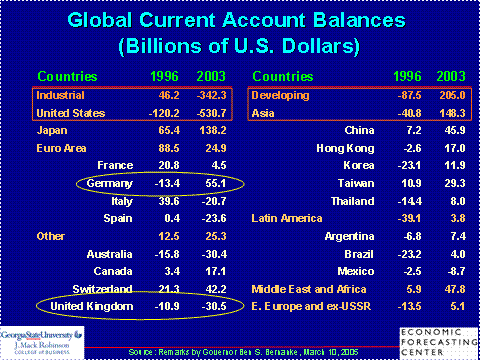
First, you heard about global
savings gluts, meaning that there’s too much money floating around in
comparison to investment opportunities. It turns out economic theory says that
money should flow from the high-net-worth, big developed countries to the
developing countries where there are frontiers for higher returns. But the
reverse has been happening since 1996. Until then the industrial countries were
net loaners of funds and the developing countries were net borrowers (Graph 4).
Now, it’s the reverse. Industrial
countries, led by the
The flip side of a trade deficit is
capital inflows. All of you in the business of investing will make portfolio
choices and so do these countries. They also have to decide what portfolio to
invest in.
What do the foreigners buy over
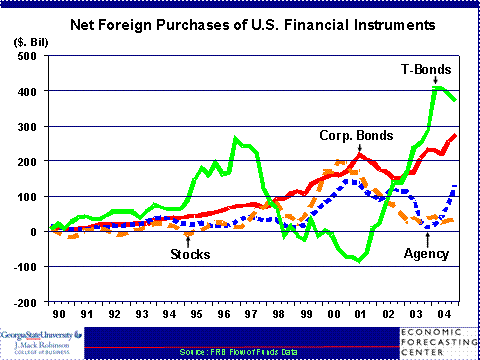
here? Graph 5 shows the net foreign purchases of US financial instruments from
foreign sources. The green line <fix reference to
fit your printed piece!> represents the net buying of Treasury bills,
the ten-year bonds. It shows that they were in big demand until 1997 or so,
when the stock market took off in the
Since then the level of foreign
activity has changed from net sales of $100 billion, to purchases of $400
billion, a flip of $500 billion. Of course, if you buy more bonds their price
goes up and interest rates come down. That’s what’s been going on. But the
issue is who is buying.
I have shown that when the
foreigners have to invest the money in the
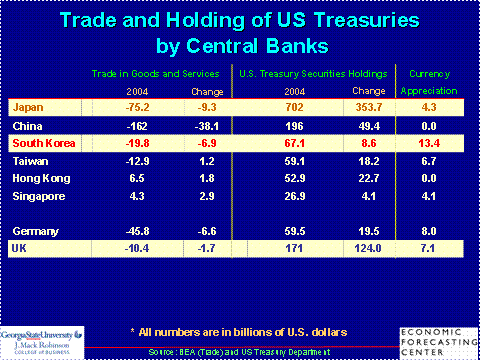
Here is the shocker. Looking at the
trade in and holdings of US Treasuries by foreign central banks (Graph 6), we
see that in one year the Japanese bought $350 billion worth of Treasury bonds.
But if our trade deficit with
Well, it seems they want to keep their currency
values low. And if you want to keep your currency low, you need to buy the
ten-year bond. The Asian Central Banks do that because of growth in net
exports, and so do the
Only
In the last four years, we in the
Let’s look at the makeup of the
trade deficit: in which commodities, and where, do we run a surplus? It’s a bit
of an eye opener. One thing is very clear. Oil and vehicles — cars and the
stuff needed to run the cars — are causing half the trade deficit. The
commodities in which we do run some kind of a surplus are airplanes, chemicals,
soybeans, corn, wheat and cotton. These last are agricultural commodities,
which surprised me. When I was learning my economics, developing countries, not
developed ones, ran surpluses in commodities. And that gave me the idea as to
what’s going to solve it in the future.
This imbalance cannot go on forever.
In real estate you always think about a seven- to ten- year horizon. Well now
just go a little bit longer and consider 15 or 20 years out. Are we going to
give up our cars and oil with a straight face? No. But if the gas price stays
high, we may economize. So we can cut down the gas bill a little bit. That
still leaves the cars, which I’ll come to. It’s not going to be that easy to
solve.
On
the other hand, if
Until then, the issue of the cars is
left. Trade data show that the
I recently ordered a BMW and nine
months later when it was delivered the price was cheaper and the Euro had gone
up by 20 percent. The car was produced in
What’s the next step? When the
Japanese were forced to voluntarily restrain exports after 1984, they saw that
they were taking on the hassle of currency and political risks. So in the
1990s, they came over to the
One day while I was musing about
this concept, my assistant director, who reads the newspaper too, said, “What
about
So there is no option. Why are these
people building those cars to sell over here? They are going to bring the
plants over here down the road.
Meanwhile, we are going to have our own problem with
GM, which right now seems to be in business just to service the pension plans
of the workers. I have been working on this issue for the last ten years with a
professor friend of mine. We have compared Japanese and
So what’s the issue and what is the solution? There
are some steps the laggards could take. First they could follow the Japanese
just-in-time practices, increase volume at the plants, steps economists would
describe as standard stuff. Second, they could negotiate with the unions.
That’s obvious. Third would be to bring back some creative designing to appeal
to customers.
But the ultimate step I suggest is,
instead of giving the top management stock options, give them the company’s
30-year bonds. That ties their reward to long-term results. If they screw up
right now in hiring practices and other areas, 30 years down the road they
won’t get their pensions. Make the incentive profile 30 years. Part of the
problem is that the typical CEO of a big company serves only about two and a
half years. They’re likely to be fired by the board, get their severance and go
home and retire. Why would they want to make any decisions with implications 15
years down the road? They have no incentive; they only live for the short term.
So we need to change that structure. Instead of compensating them through stock
options, compensate them through bonds. By tying the CEO’s compensation to the
company bond, if he hires somebody and they mess up later on, they’ll pay the
price.
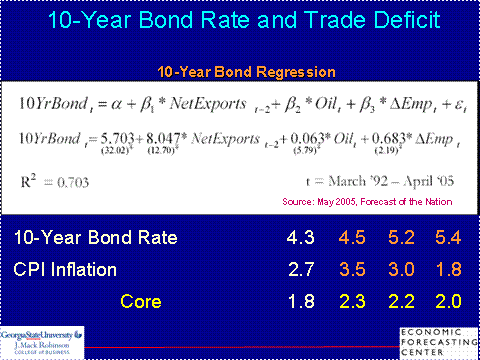
Getting back to the ten-year bond rate and the
influence of the trade deficit, I offer the regression equation (Graph 7). My
forecast is that the ten-year bond rate won’t touch 5 percent until the middle
of next year. Inflation is not going to be a problem, so the Fed will not have
to really step on the brakes.
I’ve only talked about the commodity side of the
dollar so far, but what about the value of the dollar? Two things can happen.
If you can’t sell them the other goods, you can sell them real estate. In the
national income accounts, real estate shows up as a statistical discrepancy in
the flow of funds — there’s no category for real estate. I have been talking to
Federal Reserve Bank officials, trying to figure out how to track when somebody
in
To give you an example, our trade
with
Ultimately,
the value of the dollar will fall if you keep on running this kind of deficit.
We’ll need to sell them something, so there have even been jokes that the world
can come and get its plastic surgery here, [laughter] we’ll sell services.
But there’s another issue. What
creates jobs? I came across a Dilbert series about outsourcing. (Only I can get
away with this stuff about
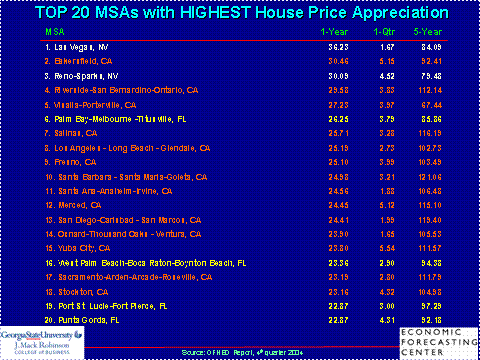
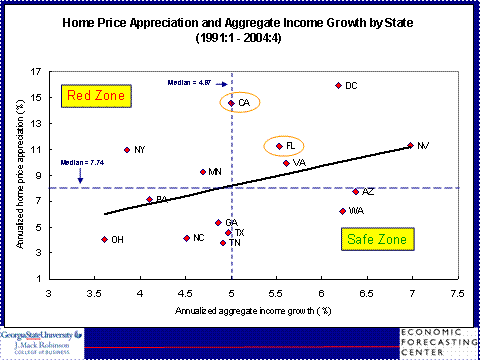
Looking at the housing market, I
have a crazy chart (Graph 8). It shows activity in the markets with the fastest
home price increases, and they are all in three states:
I can explain it in
What this shows is that if you try
to go to statistics to prove there is a bubble, you cannot. Statistically,
bubbles are nothing but non-fundamental solutions to a different situation.
It’s like beauty. You can’t define it but when you see one, you know.
The public has used houses as a bank
and taken money out in the form of home equity credit. But the productivity of
this depends on the use to which the money is put. If you take the money out to
pay down expensive debt, I like it. That’s the beginning of entrepreneurship.
That’s how people build new businesses. I love that activity.
What about the consumption of
durable goods — a big- screen TV, for example — is that investment or
consumption? Economists will classify it as consumption, but I say it might be
investment. When I watch the TV and I see those nice movies, my mind feels
light and I am more productive at my job the next day. I can justify it.
[laughter](My dad said I could justify anything.)
What about using the money to take a vacation to
One thing I do not recommend you should do, which you
probably won’t like, is to take the money out and send your kids to Ivy League
schools. Why? Has any kid ever paid back their parents? [laughter] The
homeowner is taking the risk. The kid eventually earns a great income,
hopefully, so the household as a whole benefits, but the inter-household
dispersion of risk is different. So save your money, send them to the state and
local colleges. (Send them to
One thing everybody wants to talk
about these days is Social Security. Private accounts, is it going bankrupt,
what’s going on? This is a problem that is going to happen in 2042. Do you
care? Neither do I. Okay.
Health care is hitting us right now.
If we keep on growing and aging when there are not enough young people then, as
a proportion of GDP, the 9 percent of your paycheck you are giving for Medicare
and Medicaid will go to 13 under simple assumptions. If I blow the forecast a
little bit, it goes to 21 percent; a little bit more, it goes to 30 percent. Are
you going to pay one-third of your salary as taxes for Medicare and Medicaid?
No.
So how do you solve this problem? A
politician will recommend tax hikes and benefit reductions, as will an
economist. For the other recommendation you must blame my mentor, who is a
Texan. That solution is to ship the boomers to
The technical solution is to bring
in hundred million immigrants. That means 10 million per year. Right now legal
immigration is less than three-quarters of a million a year, at which level
it’s causing social and political problems. Ten million is impossible.
Additionally, even if it was possible politically and socially, there are not
enough people in the world, not even in
Some years ago, I heard my mentor talking about this
problem. He noted that 90 percent of lifetime medical expenses happen in the
last six months of your life. If you could eliminate the last six months, this
would never be a problem. [laughter] But how do you do that? If I live to be
85, I want to be going to work in the morning, doing my nice job, coming back
home to light up a Cuban cigar and have my nice scotch and drop dead of a heart
attack. Done. Gone.
Of course that’s too radical. But
luckily economists came along and distinguished between medical advances that
prolonged the productive life span and those that prolonged the actual life
span. We’re already able to prolong the actual life span. What we need is
techniques to prolong productivity. With that I will end, leaving time to take
some questions.
Question
Thank you very much for that very
delightful presentation. You talked about some structural imbalances in the
Dr.
Dhawan
The question is what about the
current big budget deficits, which will be exacerbated with Katrina.
As I said, the budget deficit turned out to be not a
problem because we financed it by printing the ten-year bond. We monetized it
and the foreigners were holding that bond. So we were very lucky the last five
years, given that the world economy needs a certain amount of dollars, in the
form of the ten-year bond, to make it work, kind of like the grease. So as long
as we keep the deficit around $300-$400 billion at the most, not forever but
for a few years only, you can pass on the extra bonds. For that reason, I am
saying that for a year the ten-year bond will remain low. Ultimately, with all
this spending, it will catch up. There is a limit to how much the foreigners
can absorb. But as long as a substantial part of Asia and quite a few other
countries want to have an export-led growth at any cost, and as long as they
have the US as the ultimate consumer, this game can go on for another four or
five years easily. The issue would be that it can’t go on for 20 years.
Follow-up
Question
… Which makes the
Dr.
Dhawan
It makes it a little more risky, but
I point to one thing. You hear a lot about the risk of the Japanese and Chinese
deciding to dump the Treasuries. But what would they buy instead? That’s the
answer. I would love to hold Australian bonds in my portfolio, they are rock
solid, and they pay well. But I think one bank in
But a bond market is totally
fractious. There is no central clearing place. All you see on the Bloomberg
terminal is what trade happened and at what price, and that is only 40 percent
of the market. It’s like trading in islands. I have a relationship with you.
You are in JP Morgan. I am a hedge fund with ten-year bonds I want to sell. I
have been dealing with you, so I come to you. You give me almost 99 cents to the dollar.
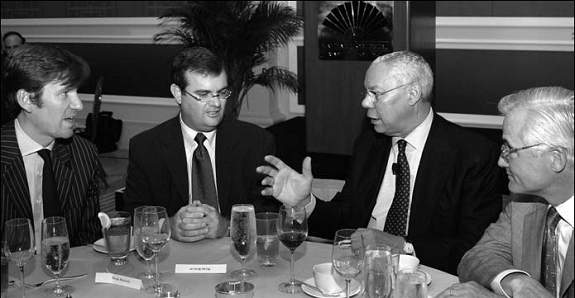
Mark Preston,
Grosvenor; Mark Baillie, Macquarie Real Estate, Inc.; Gen. Colin Powell;
and Steve Zoukis,

When the LTCM collapsed it
was because, when they were making money, they were lording it over all these
Wall Street guys and ticked them off. When the day came for their collateral to
be liquefied, the Wall Street guys weren’t too happy with them and offered 80
cents to the dollar for the bonds they were holding. When they balked at that,
the Wall Street guys got even tougher and paid only 60 cents to the dollar.
Unlike in a stock market where there is a central market clearing mechanism, in
bonds it’s nebulous. There is no market clearing.
So as long as that is the case,
what’s going to happen? Suppose ten years down the road I see the Japanese
selling Treasuries and taking the money back to their country because the
economic prospects have suddenly changed. You know what you are going to do?
You’re going to follow the same trail and go where the best return is. At that
point, you may suffer capital losses by selling the ten-year bond, planning to
make it up on the investments from
In the end, it’s all a question of
economic opportunities. Why does the European money flow over here for real
estate? Because the returns at home don’t look too good. The 4.5 percent return
over here on the ten-year bond looks great compared to the 3.2 for the German
one. It’s a case of what kind of risk you want to take, where the returns are
and how the money goes.
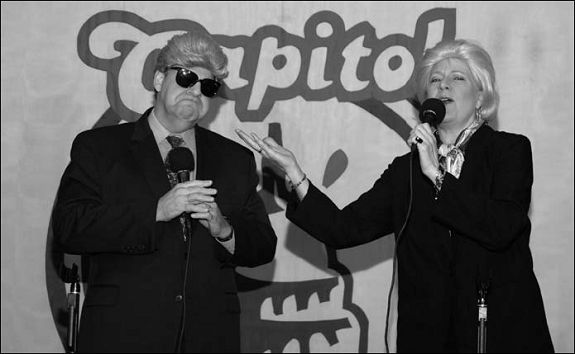
Capitol Steps
imitate Bill and Hillary Clinton
Question
Could you comment on the likelihood
of an inverted yield curve? Since in the past we’ve seen a fairly good
connection between sustained inverted yield curves and recession, if the yield
curve were to invert what are the risks of a recession in the
Dr.
Dhawan
I think you answered most of the
question yourself. Sustained inverted yield curve. A yield curve did invert a
little bit a few years ago and there was no recession. The issue is separate
from the inversion of the yield curve; the absolute level of the interest rate
matters. The best example is 1990.
Right now, any inversion would be
happening because of the trade deficit. I firmly believe when I build the
models, that every time you grow the GDP, your imports have to grow in
proportion. When the imports grow, so do your inventories and so does your
consumption, so there’s always going to be some kind of a deficit. That’s why I
put up that global savings chart. If you notice,
Also, as long as you have other
assets to sell, real estate, parks, land, beachfront in
Question
Back in the 1970s, you heard a lot
about the challenge of recycling petro dollars. Today I haven’t heard too much
about that. I wondered if you have looked at where the excess capital from high
oil prices is going.
Dr.
Dhawan
The trouble is the Treasury data for
last year didn’t show much because things are only happening in the last 9
months. Only when the data come out in another 6 to 8 months will we know how
they recycled it.
But one thing does show. Middle Eastern oil is priced
in dollars and commodity trading is in dollars. But only 10 percent of Middle
East imports are from the
Question
You mentioned that the deficit is
not a problem as long as investors are willing to hold the ten-year Treasury.
And you made the good point about Australian bonds – there are not enough of
them. Ten or 15 years from now, what would it take for the Chinese to have a
ten-year bond that the whole world wanted to hold and what would the world look
like if they had one?
Dr.
Dhawan
I think your question is very good,
but you have to tell me. They are still playing with a pegged currency, almost
a basket of goods. They don’t have a currency people automatically want to
trade in. First you have to have a currency investors will willingly hold and a
central bank with a reputation as an inflation fighter. There are a lot of ifs
there. The best thing
Their biggest mistake was to give in
to the political demand from here to take away that coupling. Having
implemented the coupling because they didn’t have the reputation, why give it
up without having an independent central bank, with the government still
running a commodity economy and without knowing what’s going on? Technically,
they have only upped the currency by 2 percent, but if they allow it to float
by 0.3 percent every day, technically in a year it will appreciate by 20 to 30
percent. At that point, it will become a problem for them because
It’s another case of a big buyer and
a big supplier, a bilateral monopoly. The solution is indeterminate; it all
depends upon bargaining power, but who has the guns? So I don’t see
I say that because