Housing Bubble
Myths: Florida And California
November 8, 2005
Dr. Rajeev Dhawan
Director
Economic Forecasting Center
Robinson College of Business
Georgia State University
|
|

Runway home prices in certain parts of the country,
especially in Florida and California, have become everybody’s worry. In
my last quarterly outlook, I tackled this issue from a statistical perspective
and found little support for the existence of a bubble in these two states. My
conjecture was that Florida and California, being
coastal states with lots of international connections, are benefiting from
foreign buyers. The Florida
chapter of the National Association of Realtors released a study recently that
showed 15% of all homebuyers were foreign (www.realtor.org). That is enough
added demand to cause not froth, but a blowout in the market. Almost 40% of
these foreign buyers buy for investment purposes and another 40% buy for a
second home. Almost 50% buy at and above the median home price in Florida, and 40% pay
cash.
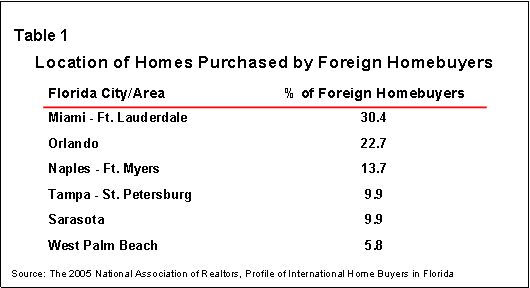
Table 1 details the metro areas in Florida where foreign
buyers were concentrated. The deeper south you go in Florida, the more this proportion is of foreign buyers. Here are some other interesting facts from
the study: one-third of foreign buyers are from the United Kingdom. It’s cheaper for
them to buy a ½ million dollar home in Florida
from the proceeds of a two-bedroom flat in London thanks to the cheap dollar! To boot,
they cited cheap transatlantic airline tickets as a big draw to live in Florida. The next big
category is Latin Americans, about 20% of the total, of which over 1/3rd
are Venezuelans. We can thank Hugo Chavez for driving his well-heeled to Miami. Political turmoil
in Argentina and Venezuela has always been good for Miami’s real estate. The
Germans, who make up 7% of the total, come to retire in large communities, and
they get a better return here than investing in their own country’s residential
real estate market where prices have been falling for the last few
years. Net-net, the Florida
retirement market has become international and no longer confined to Americans.
This shift in the demand curve can explain Florida’s froth.
|
|
|
|
|
But what about California? Yes, it is
close to Latin America and is initially is the
first choice for Mexican nationals and Central Americans to find work
opportunities. Investment motives only develop later, once they feel settled.
It is not as Latinized as you may think. I
haven’t seen a study from the California Association of Realtors on profiles of
foreign buyers (but I am sure their chief economist Leslie Appleton-Young is
getting it done). In a very candid speech on September 26th, Greenspan
commented on California’s
real estate froth (www.federalreserve.gov):
“These estimated LTVs are
highest in states that have experienced relatively little house price
appreciation, and lowest in states in which prices have appreciated the most,
such as California and Massachusetts. The main reason for this
negative relationship is likely that most people buying a home in California
are probably also selling a home in California and using at least part of
their accumulated home equity capital gains as a down payment on their new
house. Apparently, many households are forgoing some consumption to lower their
new mortgage balances.”
Now, please don’t be as scared as Bill Gross, who lives
in a beachfront property in Laguna Nigel in Southern
California. Greenspan had this to say at the end of the speech for
his comfort:
“Thus, the vast majority of homeowners have a sizable
equity cushion with which to absorb a potential decline in
house prices.”
With that cheery thought, happy
holidays to y’all from the ATL.