Housing Bubble: Reality and Solutions
August 15, 2005
Dr. Rajeev Dhawan
Director
Economic Forecasting Center
Robinson College of Business
Georgia State University
|
|

But what about the presence of a housing bubble, especially in the
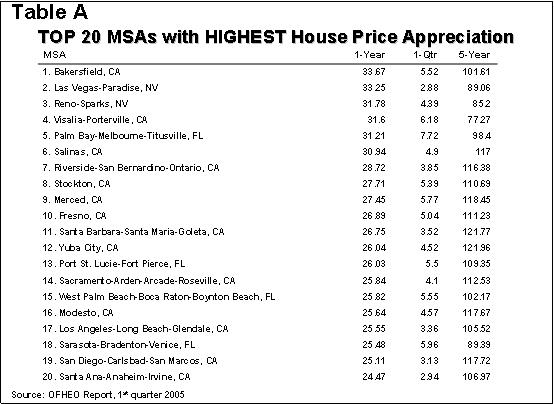
coastal regions and states showing red-hot price appreciation rates? Table A shows the
top 20 metro areas that are on fire. Note that all of them have shown 20%+
gains in just the past year, and they all belong to just three states--Florida, California and Nevada. These price
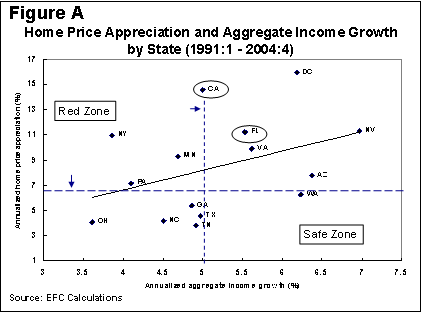
gains seem absurd at first glance. Figure
A shows, common sense can also be misleading. This graph shows the
home-price appreciation rate plotted against income growth for all the US states over
the last 14 years. The red zone is the quadrant where income growth lags
home-price appreciation by a wide margin. I expected to see the aforementioned
three states in the red zone. But surprises never cease. New
York and Minnesota are in the red
zone, whereas California falls on the border
and Florida
is far away from it! This proves the point of a theoretical paper, also echoed
by Greenspan in his speech in 1999, that it’s difficult to statistically prove
that there’s a bubble from a policy-maker’s perspective. It’s foolish of me to
even try this exercise.
We
definitely have a home-affordability problem in coastal areas and a few key
inland markets such as Las Vegas and Phoenix. As long as
foreigners covet a piece of U.S.
property in lieu of us consuming their goods, this side-effect of our
consumption binge will continue. Why, you ask? To pay for the trade deficit
resulting from excess consumption, one has to sell assets to the lender, and
they interestingly can be of any type. Only for poor, unfortunate, emerging
economies is the range of liquid assets limited to hard US currency.
That takes care of the demand side from the preference perspective to quite an
extent for these coastal markets. On the financing side, the judgment day for
option ARM loans, interest only mortgages, and parents helping grown-up kids
buy their first home by using their accumulated home-equity as a down
payment--natural tools to combat the affordability problem by unfortunate
locals in these states--is not due for another five years or so. This is the
typical profile of these types of loans. A lot can happen on the positive side
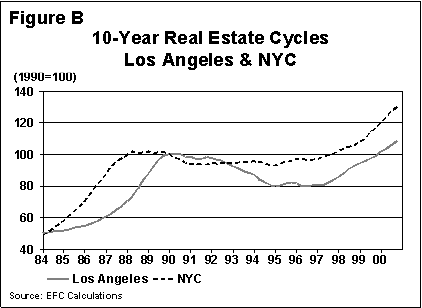
in between. Even if a correction happens before these five years are over, I
have a chart that shows what
home owners can expect. All they have to do is wait out about
five years before their property values (of an average house) regain their lost
ground. Figure B displays
from the aftermath of bubbles in New York and Los Angeles.
This
graph, however, motivates a very pertinent query. What was the reason behind
the popping of these real estate bubbles? It couldn’t have been a reduced
desire on the part of foreigners to buy US assets as this reasoning would have
precluded the steady increase in trade deficits experienced in the last two
decades. As it turns out, the culprit always is a regional shock to the
manufacturing employment base. When the Berlin Wall came down in 1989, the
peace dividend arrived in California
in the form of quarter million job losses in the aerospace industry in just
under two years! Yes, that figure is correct, and was a massive shock to a
single industry’s few big firms located within ten miles of each other. As a
young grad student at UCLA I was there first hand to witness the deep misery in
the lovely city of Angels. The same can be said of home price declines
in Houston (caused by the oil crash of 1985), Boston (three big firms in the mini-computer industry with
simultaneous layoffs in 1988) and New
York City (massive layoffs in response to the
stock-market crash in October 1987).
Thus,
the common thread is a massive external shock to a premier, well-paying job
provider. It always starts at the upper
end of the employment scale. It then gets magnified due to other external
factors such as a recession caused by an oil shock and coupled with high
interest rates, as the FED is often fighting an inflation war at the same time.
I don’t see a scenario such as this in the near future.