Oil: Myths, Realities and Conjectures
August 15, 2005
Dr. Rajeev Dhawan
Director
Economic Forecasting Center
Robinson College of Business
Georgia State University
|
|

What has
made oil prices shoot up in the last three months and why don’t I expect it to
cross $75 and stay there? After all, Goldman Sachs made the call this past
spring that oil will touch $105 by 2007. First let’s investigate what made it
climb to the same lofty perch as in the mid-1960’s.
The Middle East gets most of its imports from the EU but has
to earn its living in dollars. Thus, because of the weak dollar, the purchasing
power maintenance can explain the move from $25 to $40 at best. The rest is
still a challenge. One can throw in the usual suspects—hurricane-related crude
production disruptions in the Gulf of Mexico, a terror premium, bottlenecks in
transportation capacity—but they will explain only part of the froth in the
market, say the move from $55 to $65 a barrel. We still need to explain the
move from $40 to $55. Hence, I decided to check the most prevalent thesis in
the media that CHINDIA—the combination of the Indian consumer and the Chinese
producer—is causing this pressure on limited global supplies.
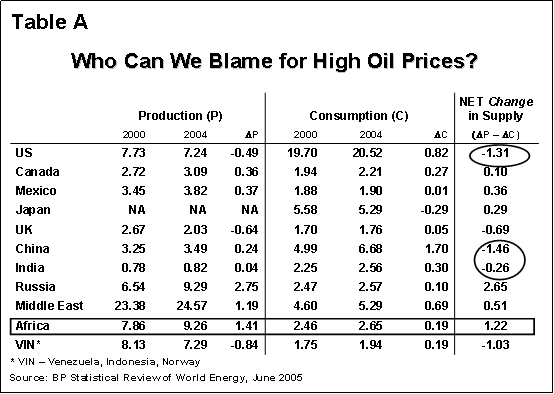
Table A shows production and consumption of oil by major producers and consumers
around the world. The first few columns display production of oil in 2000 and
2004 for the countries listed, and the net change in production over this time
period. Similarly, the next three columns show consumption and net change. An
interesting thing is that the US,
the UK and VIN (Venezuela, Indonesia
and Norway)
all decreased production for a total of about 2 million barrels per day. But
this shortfall seems to have been made up by increased pumping in Russia, OPEC and Africa.
Hence, there doesn’t appear to be an oil shortage per se. However, this is only
part of the story. When one factors in the demand side, one notices that China and US
are the two entities that have shown solid increases in consumption during this
time. India
seems to be somewhat behind by the absolute metric of change in demand (of
course, not in percentage terms). The last column is labeled as net change
in supply, i.e. change in production less change in consumption. This is a
metric designed to capture the pressure a country’s demand puts on the oil
market’s clearing price.
By
this metric, both China and
the US
are fighting for new oil supplies coming from non-OPEC sources. Furthermore,
given the realities of existing pipelines, shipment logistics and historical
contract relationships, excess oil from Russia and
Africa
flows more easily to the US
and Europe than to China.
Thus, when China
goes about looking for extra oil in the open market but can’t find it from its
historical OPEC suppliers, it is forced to bid higher on the spot market. This
price signal is then interpreted as a “sustained” increase in demand by market
participants who in turn bid up prices in the futures market for delivery three
to six months down the road. Add to this mix the desire by US hedge funds to
make a quick buck
from speculation, and you
can understand both the creep up in oil prices and the volatility of oil price
futures. So how long will this schizophrenia last?
My
view is that the oil market is ready for a correction. As China achieves
its goal of orderly moderation in its runaway investment spending and our own
Greenspan manages to cool the ardor of local home builders, the resultant drop
in global demand will self-correct this problem. Trust me, a sustained $3 plus
a gallon of gasoline at the pump will make even lead-foots like me drive
conservatively. This force is very strong but it takes while to register. Mind
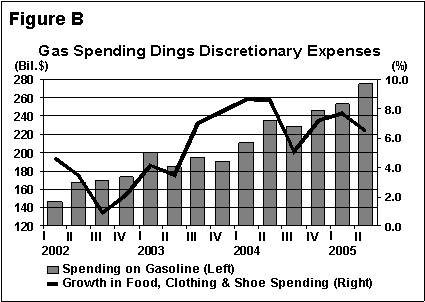
you, car discounts only delay the inevitable. Figure B, meanwhile, shows
that people’s discretionary spending has already been affected by high oil
prices. This graph charts gasoline spending by consumers in nominal terms from
national income accounts. Since late 2002, of the extra $120 billion on gasoline
spending that the consumer had to find to feed its oil habit, about 1/3rd
has come out of
spending for clothing, shoes and food. Recently, this category’s
growth acceleration has stopped in its tracks, as the graph clearly shows. The
rest has come out of savings, drawing down home equity credit lines, less
spending on recreation and the ongoing transfer of auto shareholder’s wealth to
the consumers via numerous discount schemes. Either way, people have been able
to finance this habit much more easily here than I can say for Europe, where
high gasoline taxes raise prices exponentially at the pump and crimp their
consumption spending.
Now,
let’s not get the idea that higher fuel taxes will solve our problem and cause
a quick correction in the market. High taxes at European levels would not only
lead to resentment (or a second revolution if ever implemented) but fill the
coffers of local and state governments, who will fritter them away any which
way they can. I remember in the heyday of the dot-com boom, the City of Santa Monica redid their perfectly good
sidewalks as the city had the money budgeted for the work.
China’s bid to buy UNOCAL got a lot of bad press for all
the wrong reasons. The charge was that CNOOC was a front for the Chinese
military, which is correct, but then again what major Chinese enterprise is
not? The paranoid claimed that if China
were to get their hands on precious oil supplies, it would allow them to hold
the US
hostage in the event of a future conflict between these two countries. This is
sheer nonsense—but trust politicians to exploit this skewed point-of-view to
the hilt for a few lousy anti-foreign votes. China needs a stable supply of oil
to feed its voracious production machinery to supply goods that the West
consumes. These poor guys are just watching out for their production ability
like any capitalist company.
Did
anybody even think that this motive will also make China more of a model state, one
interested in global peace to ensure oil supplies? This line of thinking might
be more productive than berating and threatening them for Taiwan at every
opportunity. The Chinese have simply learnt from Japan’s futile attempt at
exploration to find domestic supplies after the OPEC oil-embargo in the 70’s.
If China is unable to buy
existing oil companies due to political opposition in the US, it will go to the last frontier, which is Africa. Note also from table A that Africa has increased its net
supply at a rapid pace over the last few years. Sudan, as its internal political
fratricide abates, is pumping out almost half a million barrels of crude oil! Nigeria is ramping up its capacity and so are South Africa and Angola. This numerical fact
explains my amazement when Bush stood with Blair and other G-8 leaders and
pledged to increased financial aid to Africa.
He gets unjust criticism for pandering to the Saudis whereas the new game in
town is the African continent.
And
let’s not forget Russia.
The West is chummy with Putin—Bush's soul mate—and
the Chinese have swallowed their disgust at this neighbor’s liberalization
efforts and warmed up to them.
Another
factor that helps consumers weather the current oil-storm is the break in mortgage
payments over the last four years since the FED began their reflationary
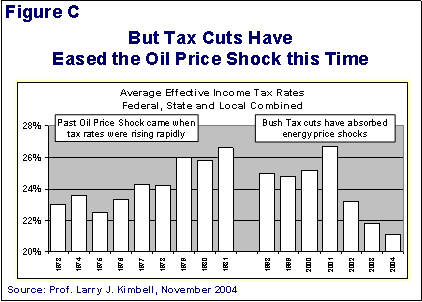
campaign. More importantly, inflation is not a problem this time as it was in
the 70’s. Figure C shows,
courtesy of my mentor Prof. Larry Kimbell, effective
tax rates in the 70’s climbed sharply when inflation led to a bracket creep.
This time, whether you liked them on not, Bush administration’s tax cuts eased
the oil-tax burden. Unfortunatley, no new tax cuts
are on the horizon but neither is another fifty percent run up in the price of
oil.