Bet on the Stewardship of the Fed
August 14, 2006
Dr. Rajeev Dhawan Director Economic Forecasting Center

Our experience in the 1970’s
showed that once inflation takes off, it will feed upon itself. Once this genie escapes, it is hard to put it
back in the bottle. So the right policy
response to an emerging inflation threat is to be pre-emptive by aggressively
tightening in the early stage. The Fed
has done just that with their seventeen 25-basis point hikes. Bank economists are even asking for a couple
more just to be safe. So why doesn’t the
Fed take this insurance to protect us against such a malady? Isn’t the unit cost of labor accelerating
while productivity growth is slowing, fueling inflationary pressures in the
future? Can we really bank upon the mild
projected slowdown in growth to reverse the rising tide of inflation? This is
precisely what Martin Feldstein debated in his August 7th op-ed piece in the Wall Street Journal (WSJ). He was questioning the wisdom of the Fed stopping
now when the real interest rate is barely 1% when generally, the economy
requires a much higher real rate to tame inflation. Volcker had to go
as high as an 8% real rate in 1982 and even the cautious Greenspan went to a 3%
real rate in 2000. So why stop now at 1%?
If I buy Feldstein’s analysis in
its entirety then the conclusion I draw is that we will need more than a hike
or two to tame existing inflationary pressures.
John Taylor, Stanford professor and former Undersecretary of Treasury,
whose work on modern macro-modeling inspired me to pursue this field, also
recommended in a July 13th op-ed piece in the WSJ that Bernanke go to at least a 6.5% federal funds rate based on
the St. Louis Fed’s version of his “Taylor Rule”. Add a few more hikes to buy insurance and
what is needed is a series of additional rate hikes totaling at least 200-basis
points! Scary, isn’t it, when you buy
into the insurance argument.
I think Feldstein’s argument is
correct in theory but isn’t applicable to the current setting. Inflation in the last 12 months, depending on
the price index you choose, ranges from 4.8% (PPI for finished goods) to 2.5%
(Core CPI). These numbers at present are
definitely outside the comfort zone of the Fed. The PPI inflation rate has been
elevated for the past few years and was this high even when the Core inflation
rate dropped sharply in 2003 to below 1.2%.
This made for a very nervous Fed that worried openly about
deflation. Additionally, when Volcker stepped hard on the brakes back in 1981, both the
PPI and the Core inflation rates were running above 10%.
The difference now is that we
haven’t seen much of a
pass-through of inflation from PPI to Core.
Whether it is due to the lack of pricing power from increased
competition or to the nature of this new era is immaterial. However, I seriously doubt that firms are
suddenly going to find their lost pricing power of the last decade in the next
few months.
What really matters is the evolution of future inflation. There is a general consensus that inflation
is a lagging indicator of the business cycle.
But the length of the lag is a pertinent question. Empirical estimates range anywhere from as
little as one quarter to about eighteen months.
If it’s a lag of few quarters, then questioning the Fed pause is a moot
issue because they are done. But what if
it is longer? Then the impact of past hikes needs
to be evaluated. This is exactly what Bernanke emphasized in mid-July at the end of his testimony
to the Senate. He said:
The lags
between policy actions and their effects imply that we must be forward-looking,
basing our policy choices on the longer-term outlook for both inflation and
economic growth. In formulating that
outlook, we must take account of the possible future effects of previous policy
actions – that is, of policy effects still "in the pipeline."
That very day he had announced
his pause in very clear English, henceforth dubbed as Benspeak. The era of Greenspeak
where we had to read between the lines to figure out what he really meant or
didn’t mean is over. Seventeen years has
taken away one’s trust in plain speak (Notice the
coincidence….seventeen years, seventeen rate hikes!). However, Greenspan was very good at
stage-managing official Fed appearances, whether in person or by his fellow
Board members or the regional Fed presidents.
This was his modus operandi after the 1994-95 rate hikes when the Fed
felt that the market was taken by surprise at the start of their rate hike
campaign in early 1994. To avoid
repeating this scenario, of which Greenspan was very successful, he would crank
up the speech routine before undertaking a major monetary policy change.
Bernanke
inherited the hike campaign when it was nearing its probabilistic end. With Fed watchers accustomed to Greenspan’s signals, we
have a bit of “unlearning” to do. Bernanke is not
going to play a saxophone to announce a permanent end to rate hikes. First, he doesn’t play that instrument, and
second, why pre-commit on rates? Just to
make life easy for bank economists, hedge funds, and home equity addicts? That’s not his legal mandate. The Fed needs to keep open its option to step
in and resume rate hikes if the economy doesn’t slow enough by fall to contain
inflation. That is why, after
acknowledging the inflation risk, the FOMC left the following clause in their
August 8th statement:
The extent and
timing of any additional firming that may be needed to address these risks will
depend on the evolution of the outlook for both inflation and economic growth,
as implied by incoming information.
Given that the FOMC statements
are terse due to space constraints, whereas I have the luxury of expounding on
arguments, I will visit the issue of what causes inflation to rise. Apart from the fact that it is excess
liquidity in the goods market, there has to be something more than too much
money chasing too few goods. That
relevant factor is inflation expectations and their evolution.
Paul Volcker was brought in to cure the inflation
malady that was raging uncontrollably due to a wage-price spiral fueled in part
by the Fed’s stop-and-go monetary policy of the 1970’s. Now, how does a wage-price spiral begin? Let’s say my wage increase request today
incorporates my expectations of a high inflation rate in the future. If I am granted this request and my wage
increase gets financed by passing it on to the consumer in the form of higher
prices, then the wage-price inflation spiral has begun. Why? Because my inflation expectations have
now come true so in the next round I will ask for more based on my current
experience. If the Fed is being accommodative
by keeping the printing presses open (figuratively speaking, as the Mint is the
preserve of the Treasury), then inflation becomes a self-fulfilling
prophecy. Hence, the wage-price spiral
requires three ingredients: bargaining or union power at the worker level,
pricing power at the firm level and an accommodative Fed ala Arthur Burns that
believes inflation is primarily due to one-time non-monetary factors. The last ingredient fortunately doesn’t exist
now and the other two have very little influence on prices.
Bernanke is
very aware of this element and he made pointed comments about inflation
expectations in his speech. He said:
The Federal
Reserve must guard against the emergence of an inflationary psychology that
could impart greater persistence to what would otherwise be a transitory
increase in inflation. After rising earlier this year, measures of longer-term
inflation expectations, based on surveys and on a comparison of yields on
nominal and inflation-indexed government debt, have edged down and remain
contained. These developments bear watching,
however.
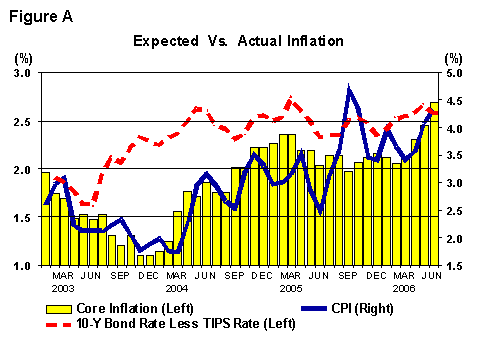
Figure A shows you the 10-year bond rate minus
the TIPS rate, a quick and easy proxy for inflation expectations, CPI inflation
and the Core inflation rate. Yes, they are higher now compared to early 2003,
but look closely at the scale.
Inflationary expectations rose from a low 1.6% in early 2003 to 2.6% by
summer of 2004, which caused the Fed to begin their rate hike campaign. Since then they have plateaued at 2.6%. If this metric starts to climb again, the Fed
will jump back into the arena. And that
will only happen if the continuing moderation in housing stops or oil prices
crash like they did in 1986, making for boom-like conditions that will then
stoke the inflationary fire. I find this
to be a very low probability scenario.
Last but not least is the behavior of the consumer in the ensuing
months. In early 2005, I was beginning
to have some doubts about our vaunted shopper’s economic acumen, and I am sure
the Fed was worried too. The fed funds
rate had been raised by 200 basis points and it had hardly made a dent to the
home equity borrowing growth rate, as shown in figure B on the next page.
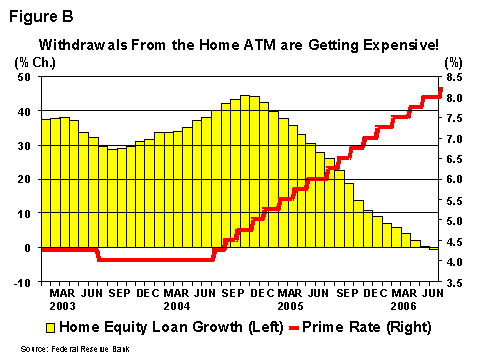
I used to display this graph in my forecast talks to make fun of consumers,
calling them home equity junkies because they didn’t seem to care about the
price of the product they loved so much to consume. Well, patience is a virtue, and finally the
expectant moderation is beginning to show clearly. The home equity loan growth rate has finally
entered negative territory. The great
game of dipping into the housing ATM is finally over, thereby taking the fuel
away from consumer spending. And with
high energy prices also beginning to cut into people’s discretionary spending,
it is not too much of a stretch to expect moderation in the economy. Bernanke had this to
say on the direction of this wealth effect:
With homeowners
no longer experiencing increases in the equity value of their homes at the
rapid pace seen in the past few years, and with the recent declines in stock
prices, increases in household net worth are likely to provide less of a boost
to consumer expenditures than they have in the recent past.
But wait a second Rajeev, what
about the impact of rising unit labor costs?
This argument is not so easy to dismiss.
Bernanke’s speech contained his clear thinking
on this issue. He said:
Profit margins
are currently relatively wide, and the effect of a possible acceleration in
compensation on price inflation would thus also depend on the extent to which
competitive pressures force firms to reduce margins rather than pass on higher
costs.
Businesses will eat up those
costs! They lack pricing power and have
ample, fat profit margins to play with so stop fussing about labor costs that
are still under control. The chances of
them exploding depends upon labor’s bargaining power, which given that only 12%
of the work force is unionized, is minimal when compared to the unionization
rate of 1960’s and 1970’s. Now I
reproduce another one of those terse but succinct statements from the latest
FOMC release to tie up this whole section:
However,
inflation pressures seem likely to moderate over time, reflecting contained
inflation expectations and the cumulative effects of monetary policy actions
and other factors restraining aggregate demand.
By now it should be clear to the
reader what these “other” factors are--high oil prices and a moderating housing
sector.
Finally, John Taylor had this
following two prong advice for Bernanke in his
article:
#1 Talk about the evolution of
the economy but refrain from doing cartwheels about the future direction of the
federal funds rate.
#2 Stick
to price stability without muddling it up with the talk of an inflation target.
The first point is nothing but
the summary of what you have read in this section about the value of
flexibility and keeping options open. On
the second point, I am very sympathetic to
The train has left the station
and there is a new conductor on board.
It’s time to hail to the new Sheriff in town!