Why
August 14, 2006
Dr. Rajeev Dhawan Director Economic Forecasting Center

On July 14, my
staff and I attended a speech given by Gerald Grinstein, CEO of Delta, at the
Commerce Club in
I applaud Delta for this savvy strategy, in fact, I recommended they do just this in an
Op-Ed piece in the Atlanta Journal-Constitution in December 2004 titled “Big
Airlines Ought to Stop Flying Solo”.
Delta’s low-cost competitors, such as Southwest, JetBlue
and AirTran, have been extremely effective in running
a shuttle service of 737s that hold 100-200 passengers and fly a maximum of
2,700 miles, such as from
We decided to take a closer at
Delta’s current international destinations to see if, realistically, Delta can
expand their international offerings as much as they say. Delta’s key advantage is its fleet of 767s
and 777s, large planes that carry at least 200
passengers and can fly between 6,400 and 7,500 miles. To put this in perspective, a flight from
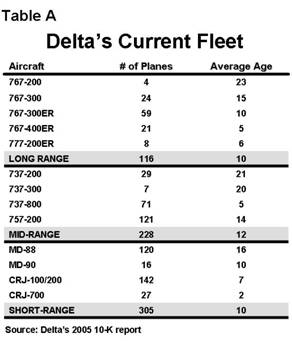
My staff carried out some good, old-fashioned analysis of Delta’s latest
schedule on their website dated July 1, 2006 and divided Delta’s international
destinations into two broad categories: Delta flights and SkyTeam
partner flights. We realized that while the Skyteam
flights may benefit Delta’s customers because it broadens their destination
possibilities, the true cash infusion comes from a passenger purchasing a
ticket on a Delta plane. Therefore, we
counted all international destinations, but for our analysis, we strictly paid
attention to only Delta flights. We then
separated the destinations into four categories: Trans-Atlantic/Pacific
flights, North American flights (only
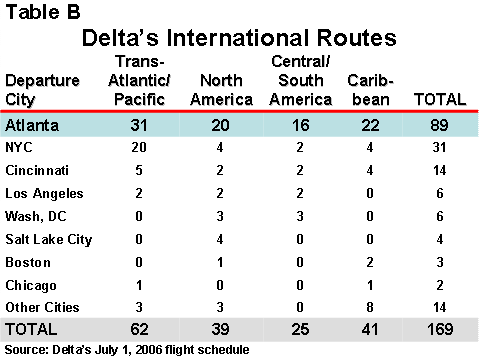
Delta has 169 daily flights to
international destinations, of which 62 are the long-rage
Trans-Atlantic/Pacific flights. We
mentioned above that Delta has about 116 long-range planes. It might initially
seem that with 62 flights and 116 planes, Delta can easily double their
international destinations because they have 60 planes sitting idle, correct?
Not quite. First of all, these
long-range flights take time. From the
U.S. East Coast to
Not only that, this one plane
per day from the U.S. East Coast – Western Europe leg is the best-case scenario
logistically. Once you cross the Pacific
or go farther east beyond Western Europe, when flight time extends to 10, 12 or
15 hours, as is the case between New York to Tokyo, the most routes a plane can
do is no longer once a day and back, but more like once every two days. Therefore, to fly the longer routes on a
daily basis, Delta must dedicate two planes per route, not just one. Additionally, considering that planes are
routinely taken out of their flying schedule for routine maintenance, suddenly,
Delta’s “excess” capacity of 60 planes no longer seems so roomy. In fact, this proves that Delta’s current
international capacity is already bursting at the seams!
Additionally, more than half of
Delta’s current 767s are over 10 years old!
According to Grinstein, for each additional year that a plane is in
operation, it loses 1% in fuel efficiency.
With so many older planes, Delta is consuming more gas per mile than AirTran, who owns an entire fleet of new planes. But wait, let’s not forget that Delta has five new
fuel-efficient 777 planes on order – to be delivered by 2009. That’s great, but not all that comforting
because they could ideally use 75 planes to replace all their 767s that are
over 10 years old. During the Q&A at
Grinstein’s speech, I asked whether he was planning to buy any new planes – and
his answer sent a warning signal. In
bankruptcy court, Delta must clear all new expenses through a budget committee. My fear is that the committee cares more
about recouping lost money for its creditors than about the future strategic
viability of Delta. Let’s hope they buy
into Grinstein’s international vision and are willing to approve billions of
dollars in funding for new planes. We
need to keep our fingers crossed on this issue.
Given that Boeing received 1,000
orders for planes in 2005 and another 517 so far for the first six months of 2006, they are making planes as fast as they can produce
them. Not only that, because of the
demand, any sweet financing deals are a thing of the past and nothing less than
cold hard cash will push an order up the delivery chain. Unfortunately for Delta, their initial
bankruptcy turnaround plan called for oil at $63 a barrel. According to Grinstein, every dollar above
$63/barrel costs Delta an additional $80 million. With oil hovering at $75 a barrel for the
last couple months, that’s already almost a billion extra dollars for fuel that
Delta now needs to come up with in addition to its projected $3 billion in
savings before it can emerge from bankruptcy.
Given the current conflict in
In conclusion, while Delta’s
efforts to expand internationally are certainly the right path to a more
profitable airline, the company is constrained by its fleet of older,
long-range planes and a lack of cash to purchase new ones. We have seen Delta announce a plethora of new
international destinations over the last year, but without new long-range
planes, I think they’re flying all they can.