Why are Oil Prices so
High?
May 15, 2006
Dr. Rajeev Dhawan Director Economic Forecasting Center

My August 2005 forecast called
for oil to moderate to $50/bbl by the end of 2007, whereas this forecast calls
for oil to be above $60/bbl by that time.
Right after the release of the August forecast, hurricanes Katrina and
Rita threw the oil market into turmoil after almost 10% of domestic capacity
was knocked offline at one point. The
post-Katrina rise in oil can be explained by this disruption in domestic supply
which happened in the face of a global resurgence in the net demand for oil, i.e. an increase in consumption in excess of
production for a given country .
My analysis showed that it was
The figure A on the next page displays the price of
oil when it was above $70/bbl in early May.
In 2002, the price of oil was $25/bbl.
The marginal, as well as the dominant, price setting producer in the oil
market is OPEC whose member countries, especially
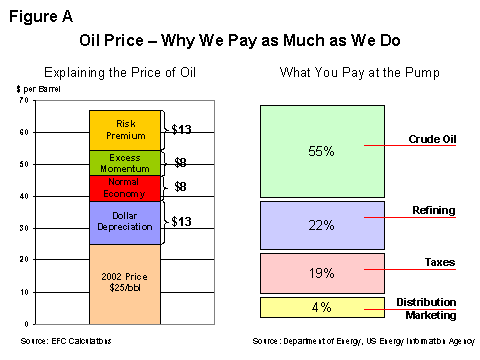
The next “Normal Economy” box
shows the rise in prices due to a strengthening economy that demands more
oil. I estimated it to be $8/bbl based
on the
One cannot easily separate these two risk premium components as they keep
changing based on events beyond the realm of economics. This very uncertainty brings in hedge funds
and other speculators who thrive on volatility to make “excess” returns for
their investors. These players,
nevertheless, play a vital part in equilibrating the market. However, they become partially responsible
for some of the misery at the pump, as shown in the right-hand panel of figure
A. More than half the cost of gasoline
at the pump is the cost of crude followed by the cost of refining. Given the current average gasoline price of
almost $3/gallon, and using the rule of thumb that a barrel of oil produces 42
gallons of gasoline, it implies a price of $70/bbl, not far from where the future
price is hovering these days. If the
gasoline price in your area is above $3, then it has to do with regional supply
constraints. Additionally, EPA-mandated summer gasoline blends require Ethanol
be trucked in from the
Now, let’s see what the situation
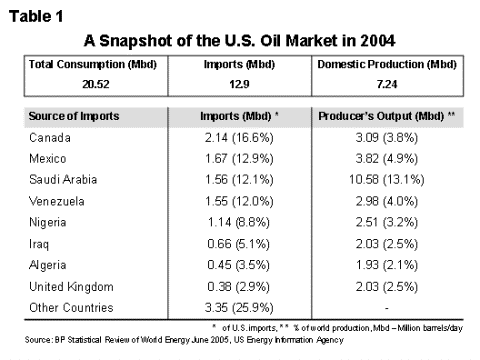
looks like closer to home in terms of the demand and supply of oil. Table 1 shows that 63% of oil consumed in the
Conservation will be an
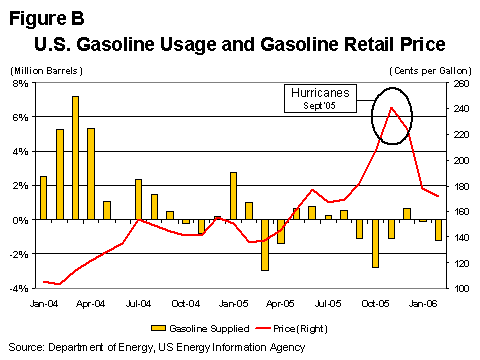
important force in reducing the dependence on imported oil. Figure B
shows the drop in the consumption of gasoline as prices peaked after Katrina
and Rita due to supply disruptions.
People became more efficient in their trip planning and the resultant
drop in consumption brought down the price of gasoline from its peak value in
September. If the prices remain
consistently high they may think about changing other aspects of their
lifestyle. However, the conservation
force will be potent only if gasoline consistently stays around $3 a gallon for
the coming years, not the knee-jerk response we see whenever there is a change
to summer-blend gasoline that causes gas prices to spike during peak driving
season. The price of a barrel of oil is
not expected to fall below $50/bbl for a while so don’t expect gasoline to drop
under $2.50 a gallon that easily. Believe me, it’s
still not high enough to cause major behavioral changes.
One important factor keeping oil
prices high over the next few years, apart from tensions with Iran and
insurgency disruptions to the delivery of Iraqi crude, is limited commercial
extraction from proven reserves in countries like Venezuela. This is not because oil companies don’t want
to extract more or that they fear further supply would depress prices (not by
much anyway). Rather, there are serious impediments to the division of profits
between the countries that own the oil reserves and the companies that must
sink in the capital to extract them. For
example,
Oil companies were burned badly
in the 80’s when oil was this high and they spent money like drunken sailors to
explore new sources. As oil prices
collapsed in 1985 and remained low in the 90’s, so did the desire to undertake
exploration risk. Now, the strategy is
to partner with a government or, better yet, get the backing of an
international agency like the World Bank to finance exploration and
development. This means that not much is
going on or will be going on in the near future. Basically, oil companies are now trading
exploration risk for political risk, which they feel they can manage
better. Why on earth they think this is
a manageable risk is beyond me.
The unfortunate consequence is
that not much new supply will come on the market in the next decade. New extraction technologies will keep output
from peaking in places like