Oil Shocks and Energy Conservation
November 8, 2005
Dr. Rajeev Dhawan Director Economic Forecasting Center

This brings me to the issue of why I had to downgrade the
negative impact calculated in early September after Katrina, even though Rita
caused more trouble in the oil and gas markets. First, oil prices have come
down sharply in the last few weeks and so has gasoline. Why? Apart from oil
refineries coming back online and increasing the supply of gasoline, people
have also very quickly conserved their use of gasoline. Currently, gasoline use
is down 2-3% from levels seen a year ago. If you add the 5% nominal growth that
the economy has experienced since then, this is quite a drop. In my view, the
threshold for a change in consumer driving patterns is a sustained $2.50 plus a
gallon for gasoline. My own personal tipping point is gas above $3.50 (having
lived in the car-obsessed culture of
It appears as if auto and light truck sales have fallen
sharply in response to high gas prices, especially in the large SUV category
and for the big three carmakers in Detroit. However, the major reason is that
This moderation effect of prices on demand will keep oil
substantially below the $70 mark for the coming quarters, barring any more
disruptions. We just dodged Wilma in late October and the season doesn’t end
officially until November 30th Oil prices are, however, expected
to remain in the $50-plus range for the next 12 months in my current forecast.
If one wants to bet back to $1.50 a gallon for gasoline, then either give me a
dollar that is 50% stronger (I can hear Boeing and other export-oriented
company execs wincing) or a sharp slowdown in the global economy, especially in
China and the US. Both of these are low probability events that you don’t want
to wish for when making a list for Santa this Christmas.
But what about the impending rise in household heating
costs? That hike is coming and is expected to cost an average household about
$500 extra this winter. This will definitely hurt consumer confidence and
short-term spending. Here again, I am betting on the conservation
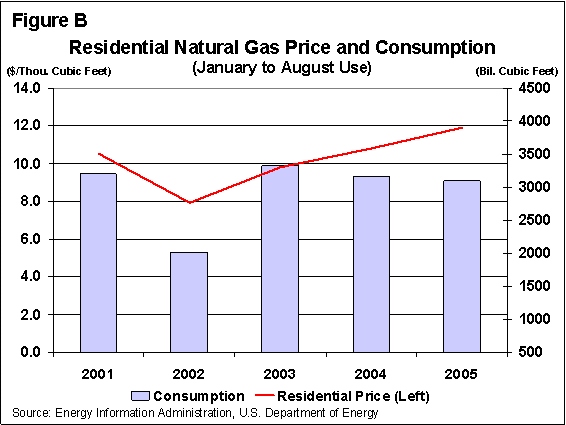
mechanism. Figure B plots year-to-date natural gas use
and the price of gas for the years 2001 to 2005. Business cycle factors play a
big role from 2001 to 2003 to explain the ups and down. Later, as the economic
recovery gained momentum, adding to the demand for natural gas, prices rose to
historic highs but the final observed demand actually fell by almost 5%,
instead of rising! Even here the price effect turns out to be stronger than the
income effect. This channel will be at work this winter to mitigate the
damage but not the discomfort.
Now, what about the impact from the rise in overall total
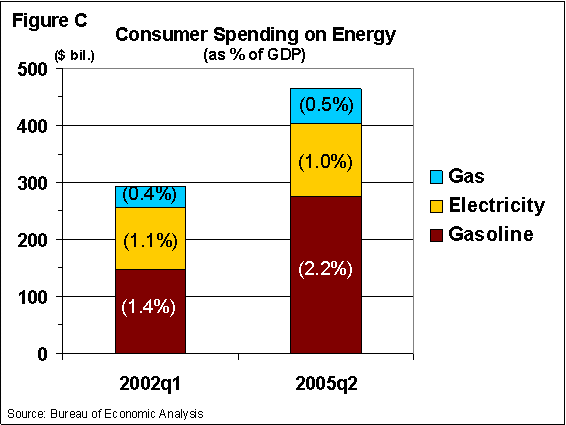
energy prices on the economy? Figure C plots expenditures of different types of energy consumption
in the economy for 2002 and 2005. One fact that is obvious from this graph is
that the nation is now spending an extra $150 billion on energy needs. However,
one small surprise is that natural gas spending as a proportion of GDP is quite
small compared to gasoline spending. We have already weathered that storm and
the natural gas one is coming in the winter for us to parry. But just sit back
and answer this simple question: Is the economy so fragile that an extra $20
billion in natural gas spending will wreck a typical household’s budget?
Low-income families will definitely feel the pinch, but
am I to believe that a middle-class household is going to tip into bankruptcy
just because heating bills increased for three months? The answer should be an
obvious “no” unless you are factoring in the assumption that dis-savers or profligate households with fragile financial
health form a very large chunk of the current population. If you believe this
hypothesis, then you must also believe that the trade deficit is a bad thing as
we are too dependent on foreign savings. I don’t remember reading anywhere in
any economics textbook that all the investment in an open economy has to be
financed by domestic savings. If you have been reading my reports diligently
(give yourself a pat if you are one of them), then you know I think that if it
wasn’t for the trade deficit, given the FED’s 12 rate
hikes, the long-bond rates would have crossed 6.0% by now. A dearth of global
investment opportunities has kept money flowing into the